
上海信弘智能科技有限公司,信弘,智能,信弘智能科技,Elite Partner,Omniverse,智能科技,NVIDIA GPU,NVIDIA DGX, vGPU,TESLA,QUADRO,AI,AI培训,AI课程,人工智能,解决方案,DLI,Mellanox,IB, 深度学习,RTX,IT,ORACLE 数据库,ORACLE云服务,深度学习学院,bigdata,大数据,数据安全备份,鼎甲,高性能计算, 虚拟机,虚拟桌面,虚拟软件,硬件,软件,加速计算,HPC,超算,服务器,虚拟服务器,IT咨询,IT系统规划,应用实施,系统集成

ZENTEK 新闻

How the DGX Spark Desktop Supercomputer Deciphers the Neural Code of Epilepsy Research—A True Story of a Scientist and a "Mini Supercomputer"

Harvard Medical School Professor Sabatini uses a desktop-grade supercomputer—the NVIDIA DGX Spark—to analyze thousands of gene mutations in real time on the lab bench, uncovering the neurological mysteries behind epilepsy. DGX Spark is now available through ZENTEK, with the first batch of units open for delivery reservations and technical support. Contact us for quotes and configuration recommendations.

Chapter One: When Mutation Meets Mystery

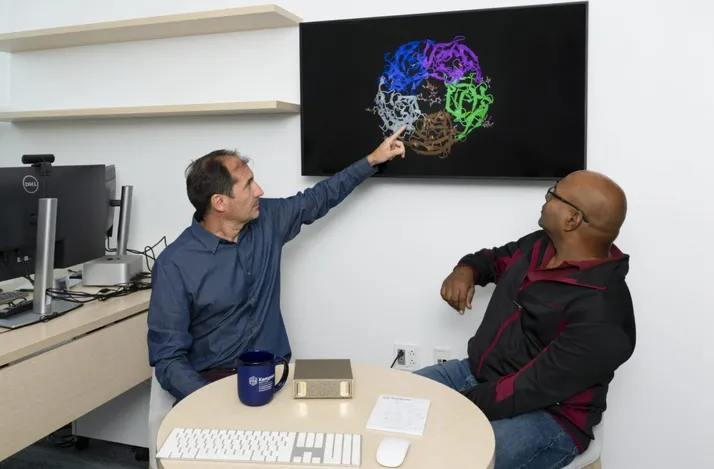
In a laboratory at Harvard Medical School, Professor Bernardo Sabatini stares at a small piece of brain tissue under the microscope. Within this tissue, thousands of neurons are silently at work—some excitatory, some inhibitory—interweaving into a delicate neural network.
Yet within this network lies a deadly puzzle: Why do certain genetic mutations, particularly those occurring in inhibitory neurons, not calm the brain but instead trigger more frequent epileptic seizures?
Professor Sabatini, in collaboration with Dr. Beth Stevens’ team at Boston Children's Hospital, recently developed a groundbreaking technique: they can introduce different single gene mutations into thousands of individual brain cells and observe how these subtle changes affect neuronal behavior.
This is an unprecedented scale of experimentation, generating massive data and complex bioinformatics analysis needs. Traditionally, such analysis requires relying on large computing clusters, lengthy queuing times, and complex IT support. But for Sabatini, the ideal scenario is to synchronize experimentation and computation—to analyze the impact of each mutation in real time, right beside his lab bench.
“We don’t want to run to a supercomputer every time,” he says. “We want a ‘super tool’ that can sit on our lab bench.”


Chapter Two: A “Super Brain” the Size of a Mac Mini

Just as Sabatini’s team was grappling with computational bottlenecks, a device no larger than a Mac Mini arrived in the lab.
It was called the NVIDIA DGX Spark, the latest “desktop supercomputer” introduced by the Kempner Institute. Though compact, it houses a powerful GPU capable of multi-precision computing at 1 PetaFLOP (one quadrillion floating-point operations per second)—enough to run complex AI tools like the protein structure prediction model Boltz-2.
For Sabatini, this was not just a machine but a revolution in scientific workflow.
“We wanted to see whether a researcher in a wet lab could directly harness such computing power at their desk,” he explains. “No cluster reservations, no complex scheduling scripts—just testing a set of mutations, analyzing their structural impact, and rapidly iterating hypotheses over a weekend.”


Chapter Three: A Story That Started With One Machine

Initially, Sabatini’s team cautiously used the DGX Spark to test small protein samples, gauging the speed and reliability of this “little box.”
They selected simple mutant proteins, ran structural predictions using the Boltz-2 model, and observed its speed, stability, and alignment with experimental data.
The results were astonishing.
“It was much faster than we expected, and remarkably stable,” recalls a lab member. “We could submit a batch of tasks before leaving work and return the next morning to find all the results neatly waiting in the output folder—like magic.”
Encouraged by initial success, the team gradually expanded their scope. Their real target was the 6,000 gene mutations potentially linked to epilepsy—especially the “paradoxical mutations” in inhibitory neurons that, instead of calming neural activity, were associated with brain hyperexcitability.
“We suspect these mutations may alter the structure of inhibitory proteins, affecting neural circuits in ways we don’t yet understand,” Sabatini explains. “But to test this hypothesis, we need precise structural prediction and functional simulation for every single mutation.”


Chapter Four: From One Machine to a Hundred, From Small Experiments to Major Discoveries

The DGX Spark became the “vanguard” of this ambitious research project.
The team first used it to screen multiple mutations on a key inhibitory receptor protein. Each simulation revealed how a mutation subtly altered the protein’s folding, charge distribution, or even binding site structure.
“We’re mapping a ‘mutation impact atlas,’” says Sabatini. “This map tells us which mutations are most likely to cause functional abnormalities, so we can prioritize them for deeper experimental validation.”
Once this map was validated on the DGX Spark, the team would submit the most promising targets to the institute’s larger Kempner AI cluster, where hundreds or even thousands of GPUs simultaneously performed large-scale simulations and verification.
“The DGX Spark is our ‘testing ground,’” Sabatini says. “Here, we can rapidly iterate, fail fast, and then use the most valuable insights to drive larger-scale computation and experimentation.”


Chapter Five: A Convergence of Science and Computing

Today, Sabatini’s lab has established a new research rhythm: experimentation and computation proceed almost in sync.
While biologists observe the behavior of mutant neurons under the microscope, computational scientists next door use the DGX Spark to analyze how these mutations alter protein structure and function. The two groups continuously communicate and refine their approaches, accelerating the research cycle severalfold.
“We no longer let computation become a bottleneck,” Sabatini emphasizes. “Instead, it has become a core engine driving scientific discovery.”
More importantly, this model—bringing powerful computing to the scientist’s bench and enabling wet-lab researchers to operate high-performance AI tools directly—is becoming a new paradigm for scientific inquiry.
“This isn’t just about epilepsy,” Sabatini stresses. “We’re exploring how neurons form complex circuits and process information at the molecular level. These discoveries will ultimately help us understand the nature of ‘intelligence,’ whether biological or artificial.”


Epilogue: The Future Starts on a Desktop

The Kempner Institute’s DGX Spark may be a small device, but it is opening a door—a door that brings computation closer to experimentation and empowers scientists to explore more freely.
In this story, there are no superheroes—only a scientist determined to unravel the mysteries of the brain, a desktop supercomputer as small as a Mac Mini yet brimming with staggering power, and a group of researchers who believe that “computation and science can be closer than ever.”
Their goal is not only to cure epilepsy but to understand the brain, intelligence, and life itself.

DGX Spark is now available through ZENTEK.
The first batch is open for delivery reservations and technical support, with end-to-end services provided.